



Sustainability
SUSTAINABILITY
Sustainability in the Chemical Industry
The chemical industry, with its wide range of products and services, is an essential part of modern life. As the sector continues to expand across numerous fields, its environmental, economic, and social impacts grow accordingly—making sustainability practices increasingly crucial. Sustainability refers to the efficient use of resources, the minimization of waste, and the reduction of environmental impacts to ensure long-term economic growth.
Core Components of Sustainability Practices in the Chemical Industry
Environmental Management
Environmental management involves developing strategies and policies to minimize the environmental impacts of operations. Environmental Management Systems (EMS) aim for continuous improvement in areas such as energy consumption, water usage, and waste management. International standards like ISO 14001 provide guidance for implementing and maintaining effective environmental management systems.
Energy Efficiency
Reducing the amount of energy used in production and shifting toward renewable energy sources lowers both operational costs and carbon footprints. By establishing Energy Management Systems (EnMS), chemical plants can monitor and optimize their energy consumption.
Water Management
Water is a vital resource for the chemical industry, and sustainable water management is essential for the protection and efficient use of water resources. Reducing water footprints and increasing water reuse are critical components of sustainable water resource management.
Waste Management
Minimizing and recycling waste generated in production processes helps reduce environmental impacts. Waste management strategies involve proper segregation and disposal of hazardous and non-hazardous waste. In line with circular economy principles, the reuse and recycling of materials are strongly encouraged.
Carbon Footprint Management
A carbon footprint measures the impact of the chemical industry on climate change. Projects aimed at improving energy efficiency, increasing the use of renewable energy, and applying low-carbon technologies are essential for reducing carbon emissions. Monitoring and reporting the carbon footprint are also important steps toward achieving sustainability targets.
Sustainable Product Development
This involves designing and manufacturing products that minimize environmental and social impacts. Green chemistry principles help reduce the use of hazardous chemicals and support the development of safer, more environmentally friendly products. Eco-design and Life Cycle Assessment (LCA) are also used to reduce environmental impacts throughout the product lifecycle.
Green Chemistry
Green chemistry promotes environmentally friendly and sustainable methods in chemical processes. It aims to minimize hazardous chemical use, increase energy efficiency, reduce waste generation, encourage renewable raw materials, and support the development of safer chemicals.
Sustainable Supply Chain
Ensuring that all stakeholders in the supply chain fulfill their environmental and social responsibilities plays a critical role in achieving sustainability goals. This includes sourcing raw materials from sustainable resources and monitoring the sustainability performance of suppliers.
Social Responsibility
Social responsibility includes employee well-being, community benefits, and supporting local initiatives. Ensuring safe working environments in compliance with occupational health and safety standards, respecting employee rights, and contributing to social projects are fundamental elements of social responsibility.
Occupational Health and Safety (OHS)
Given the risks associated with working with chemicals, occupational health and safety measures are vital for protecting employees. OHS management systems such as OHSAS 18001 and ISO 45001 provide essential guidance in this area.
Green Buildings and Sustainable Facilities
Certifications like LEED and BREEAM offer guidance for designing environmentally friendly buildings. Key components include energy efficiency, water conservation, and effective waste management.
Circular Economy
The circular economy model promotes reuse, recycling, and the efficient use of resources. By minimizing raw material consumption, it helps reduce environmental impacts and supports sustainable production.
Green Financing
Green bonds and sustainable investment funds support the implementation of sustainability-focused projects in the chemical industry. By directing investments toward projects with environmental and social benefits, green financing contributes to sustainable development.
Climate Change Mitigation
Reducing carbon emissions, improving energy efficiency, and increasing renewable energy use are key ways to combat climate change. Global frameworks such as the Paris Agreement, the EU Green Deal, and the UNFCCC guide international efforts in this area.
Conclusion
Sustainability in the chemical industry is a comprehensive topic encompassing environmental, economic, and social dimensions. As a manufacturer of PVC compounds, stabilizers, and plasticizers, our company adheres to the principles of environmental, economic, and social sustainability. Sustainability practices—such as energy and water efficiency, waste management, carbon footprint reduction, and social responsibility—are critical for the long-term success of our industry. With a commitment to continuous improvement and innovation, achieving our sustainability goals is entirely within reach.
Plastay Kimya’s Sustainability Approach
Our sustainability policy is shaped in line with the standards established by the European Union (EU) and the United Nations (UN). Accordingly, we develop various strategies based on the EU's Green Deal and the UN's Sustainable Development Goals (SDGs) to minimize the environmental impacts of our production processes.
We focus on:
Energy efficiency
Water conservation
Waste management
Reducing carbon footprint
To achieve this, we continuously improve our processes and adopt innovative technologies, including renewable energy and low-carbon systems.
In alignment with the EU 2030 Climate and Energy Framework and UN SDG 13 (Climate Action), our energy efficiency projects and low-emission technologies play a key role in reducing our carbon footprint.
We believe that collaboration and active participation are essential for a sustainable future. With the support of all our stakeholders, we remain committed to working towards these goals.
Zero Waste Certificate
At Plastay Kimya, environmental responsibility is an integral part of our corporate culture. We prioritize sustainability at every stage—from production to corporate communication—and consistently implement practices that enhance resource efficiency and reduce environmental impact.
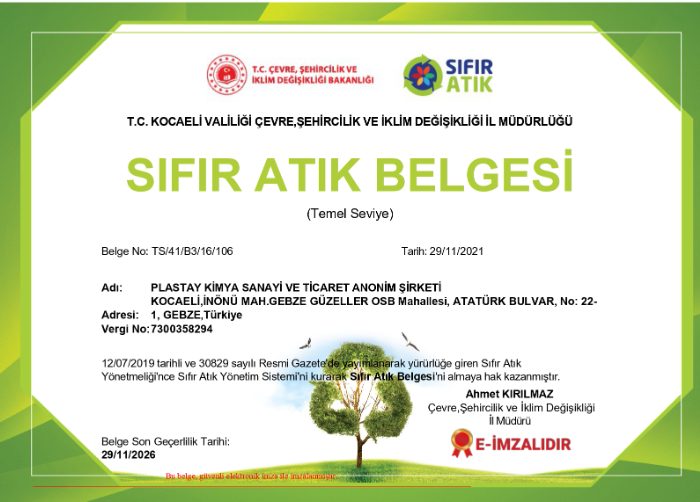
As a result of our systematic efforts, we have been awarded the Zero Waste Certificate by the Republic of Türkiye Ministry of Environment, Urbanization and Climate Change. This certificate reflects our commitment to waste reduction at the source, increased recycling, and the protection of natural resources.
Below is our certificate, representing our sustainable production approach and environmentally conscious business culture.